Friday, 18 December 2015

BEHAVIOUR OF DOGS

BEHAVIOUR OF DOGS Image result for images on dogs


Dog behavior is the internally coordinated responses of the domestic dog to internal and external stimuli.As the oldest domesticated animal behavior of dogs has inevitably shaped by millennia of contact with humans.As a result of physical and social evolution dogs more than any other species have the ability to understand and communicate with humans and they are uniquely attuned to our behaviors.These abilites are not expressed by the dogs.


The origin of the domestic dog is not clear.Whole genome sequencing indicates that the dog,the gray wolf and the extinct Taymyr wolf diverged at around the same time.How dogs became domesticated is not clear,however the two main hypothesis are self-domestication or human domestication.Dog intelligence is the ability of the dog to perceive information and retain it as knowledge for applying to solve problems.Dogs have been shown to learn by inference.Dogs have advanced memory skills,A study documented the learning and memory capabilities of a border collie,"Chaser" who had learned the names and could associate by verbal command over 1000 words.Dogs are able to read and react human body's language and pointing,and to understand human voice commands.After undergoing training to solve a simple task,dogs that are faced with an insoluble version of the same problem look at the human,while wolves do not.Dogs demonstrate a theory of mind by engaging in deception.


Dog's senses include vision, sense of smell , taste , touch and sensitivity to the earth's magnetic field.Dog communication is about how they speak to each other, how they understand messages that human send to them and how they can translate the ideas that dogs are trying to transmit.These communication behavior include eye gaze,face expression,body posture,movements of body,movements of limbs , vocalization, and gustatory communication. Human communicate with dogs by using vocalization,body posture and hand signals.
Image result for images on dogs


Play between dogs usually involves several behaviours that are often seen in aggressive encounters like nipping , biting and growing. it is important for the dogs to place these behaviours in the context to play rather than to aggression. Dogs signal their intent to play with a range of behaviors including a "face-paw"," play-bow " open-mouthed play face and inviting the other dog to chase the initiator. Similar signals are given throughout the play bout to maintain the context of the potentially aggressive activities. 


From a young age , dogs engage in play with one another. Dogs play is made up primarily of mock fights.It is believed that this behaviour is almost common in puppies.


https://trafficmonsoon.com/?ref=kapilkumar

http://www.trafficsec.com/?r=kapilkumar

Friday, 4 December 2015

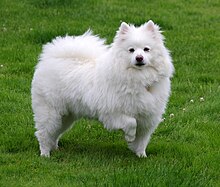
Information on American Eskimo Dog....

American Eskimo Dog

American Eskimo Dog 1.jpg
American Eskimo Dog (miniature size)
Other namesEskimo Spitz
American Spitz
German Spitz
NicknamesEskie
Country of originGermany

Traits
Coatsoft
dense
Colorwhite
country of origin: united states
Miniature
Height;12-15 in (30.5-38 cm).....females 11-14 in (28-35.5 cm).
Weight
10–20 lb (4.5–9 kg)
Standard
Height:15-19 in (38-48 cm)........females 14-18 in (35.5-45.5 cm)
Weight
18–35 lb (8–16 kg)
Coat
 Double coat with long, straight outer coat and dense, thick, short undercoat; ruff at neck
Colors
Pure white, white with biscuit cream|and cream
Other Names
 American Deutscher Spitz; American Spitz
Toy
Height: 9–12 in (23–30.5 cm)
Weight: 6–10 lb (3–4.5 kg )

ORIGIN AND HISTORY
The breed is a close relation of the white Keeshond, white Pomeranian, and white German Spitz. Perhaps because of anti-German sentiment during World War I, the breed’s name was changed in 1917 to the American Eskimo Dog. “American Eskimo” was also the kennel name of the first breeders to register the breed with the United Kennel Club  in the early 1900s.
The circus first popularized this spunky breed, when the American Eskimo named Stout’s Pal Pierre walked on a tightrope in the Ringling Bros. and Barnum & Bailey circus. Today, the American Eskimo’s talents are put to use on the competitive stages of dog obedience and agility, and he is a trusted narcotics detection dog and guard dog as well.

PERSONALITY PROFILE
Playful, charming, affectionate, intelligent, willing to please—all are used to describe the American Eskimo Dog. An energetic, spunky breed, he will develop nuisance behaviors that can be difficult to change if he is left alone too long or is not provided with proper guidance. American Eskimos are barkers, but this trait has resulted in a big watchdog in a small and loving body. He has a need to be near his owners.

CARE REQUIREMENTS
Exercise
Regular exercise will help release the American Eskimo Dog’s natural energy and stimulate his ever-present curiosity.

Grooming
Although the American Eskimo Dog’s double coat sheds quite a bit, it stays clean and white with minimal care—regular brushing and an occasional going-over with a shedding blade are all that’s needed.

Health
The average life span of the American Eskimo Dog is 12 to 17 years.
Breed health concerns may include diabetes; epilepsy; hip dysplasia; juvenile cataracts; Legg-Calve-Perthes disease; patellar luxation; and progressive retinal atrophy .
Training

The American Eskimo Dog enjoys and excels at training, where he is a top contender in the obedience, rally, and agility rings. His show-biz background is evident to all who try teaching him tricks, and he is quick to learn household rules



Thursday, 12 November 2015

solve your dog's problem today--quickly, easily and naturally

solve your dog's problem today--quickly, easily and naturally


Image result for images on dog

Solves A Desperate Problem For Many Dog Owners: Allergies And Allergic Symptoms Such As Scratching And Biting. Written By A Leading Dog Health Expert, This Informative Guide Sells Well On A Highly-searched-for Topic.Click Here!

Sunday, 8 November 2015

How to solve dog's chewing problem.....

How to solve dog's chewing problem....


Image result for How To Solve Dog chewing Problem


World Re known Animal Behaviorist And Radio Talk Show Host, Dr. Dennis Fetko, Dr. Dog Reveals His Proven Dog Training Methods. Stop Barking, Fighting, Biting, Chewing, Digging, Soiling, Jumping, Pulling And More--with No Jerking, Clicking, Or Squirting!Click Here!